Throughout the past year, we've launched a variety of updates and new features to improve your experience with AirData. We're proud to announce that the platform has surpassed 45,000,000 uploaded flight logs, demonstrating your ongoing trust and engagement with our services.
This blog covers exciting developments like our new QR Code Labels & Drone Checkouts for simplified equipment tracking, the Asset Management suite for better fleet oversight, and enhancements to maintenance customization. We’ll also highlight our streamlined certificates feature, alongside newly supported aircraft and flight apps.
My Certificates
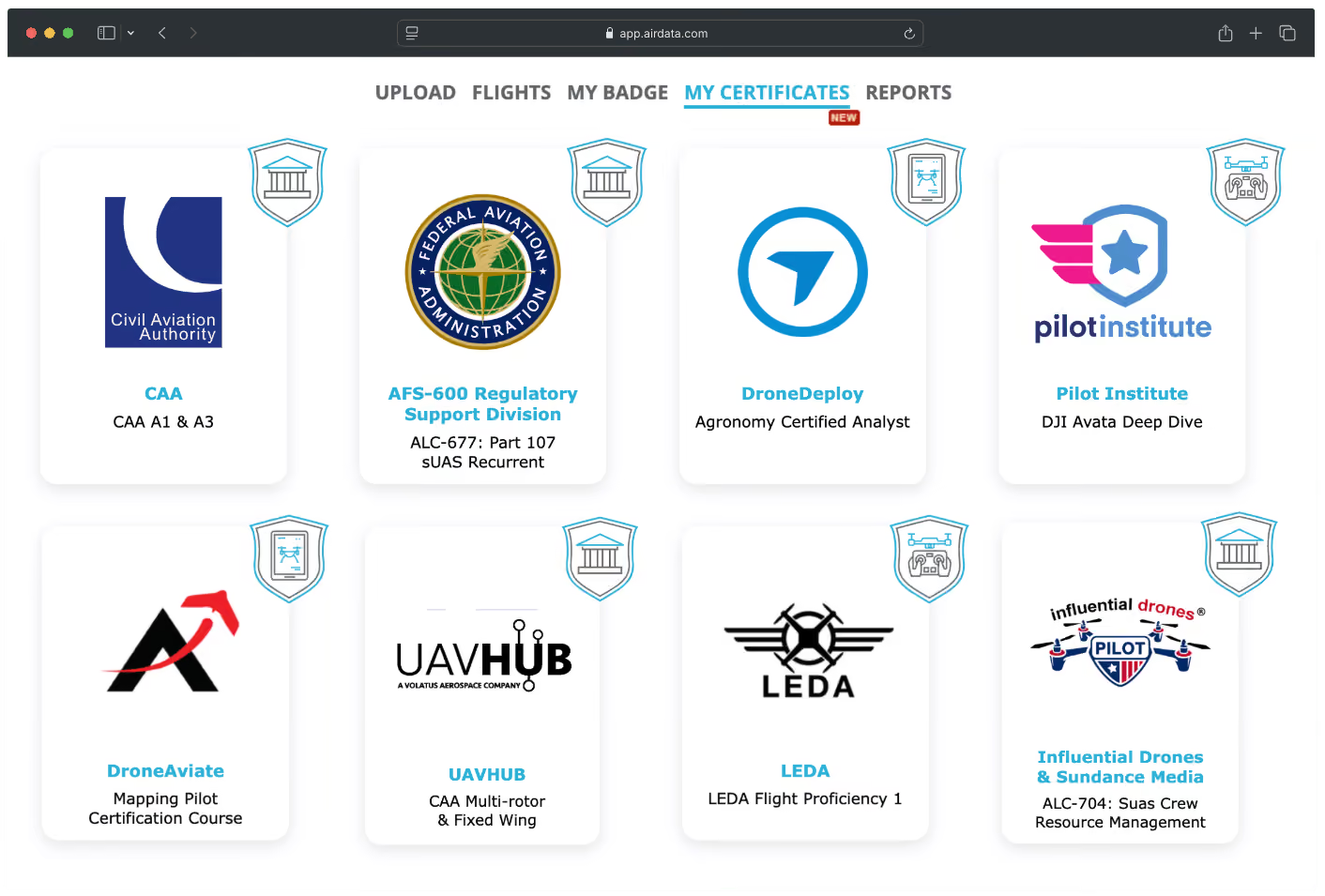
AirData now offers a streamlined way for pilots to upload training certifications directly into their accounts. The system automatically extracts key details like expiration dates and registration numbers from compatible certificate types. Certifications can be uploaded through training school integration, email submission, or manually via the "My Documents" tab. This feature is available to all users, with storage limits varying by plan. Organizations and training providers can also integrate with AirData for added convenience. Learn more about the certificates feature here.
QR Code Labels & Drone Checkouts
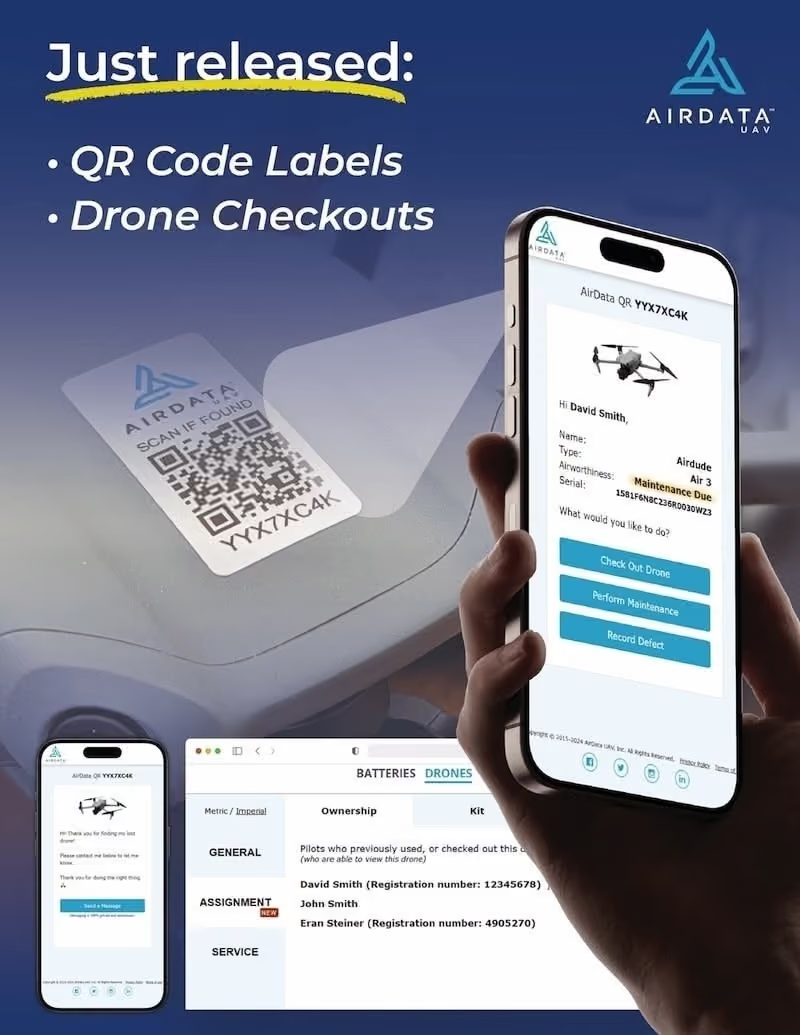
We’ve introduced QR Code Labels & Drone Checkouts to streamline equipment management. Pilots can scan QR codes to check in or out drones, log maintenance, and record defects (coming soon). Additionally, the QR codes include a "lost and found" feature, enabling anonymous location reporting.The check-in/check-out, defect recording, and maintenance logging features are part of our Enterprise plan, while the "lost and found" functionality is available to all users. Learn more about QR Code Labels and Drone Checkouts.
Asset Management
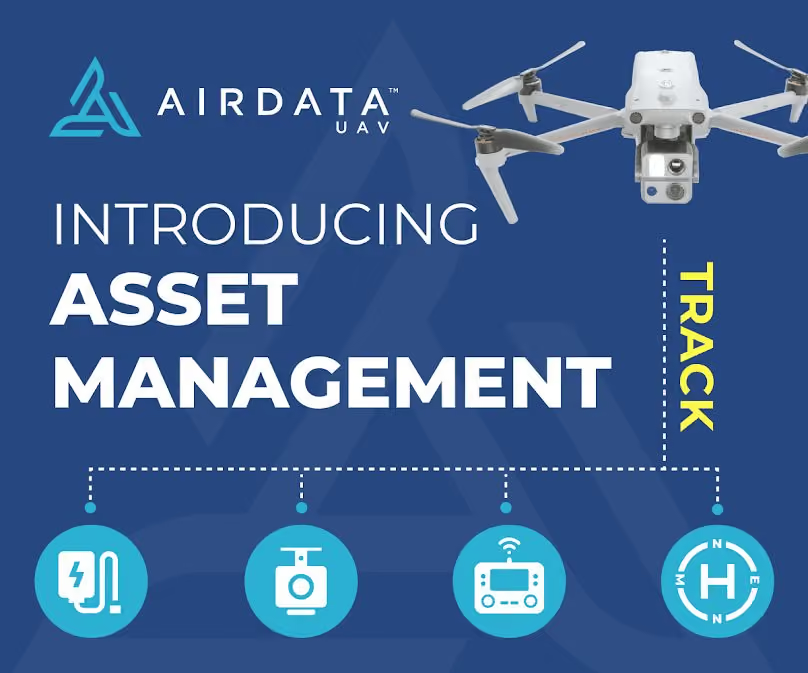
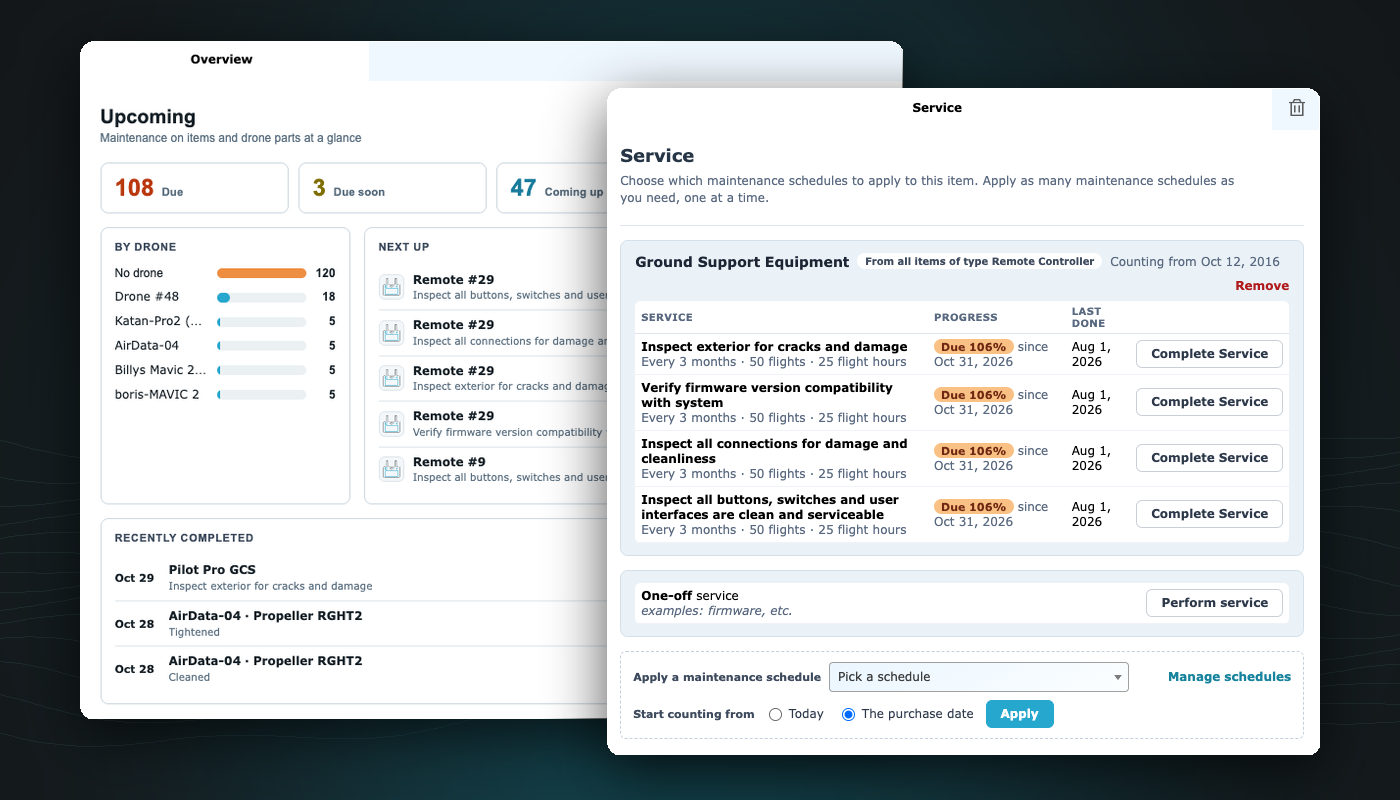
Expanding on the new QR code functionality, we've launched the Asset Management suite, an add-on to our Enterprise plan. This tool centralizes equipment management, offering advanced inventory tracking and reporting for improved control over utilization, readiness, and compliance. It logs interactions for compliance and forensic needs.
Our biggest differentiator over generalized enterprise asset management systems is the ability to focus on drone-specific workflows" -AirData’s founder and CEO, Eran Steiner
Users can customize QR code labels with details like drone names and registration numbers. We're adding features like intelligent scheduling, alerting, and equipment kits, and soon, QR codes will track items like payloads and accessories
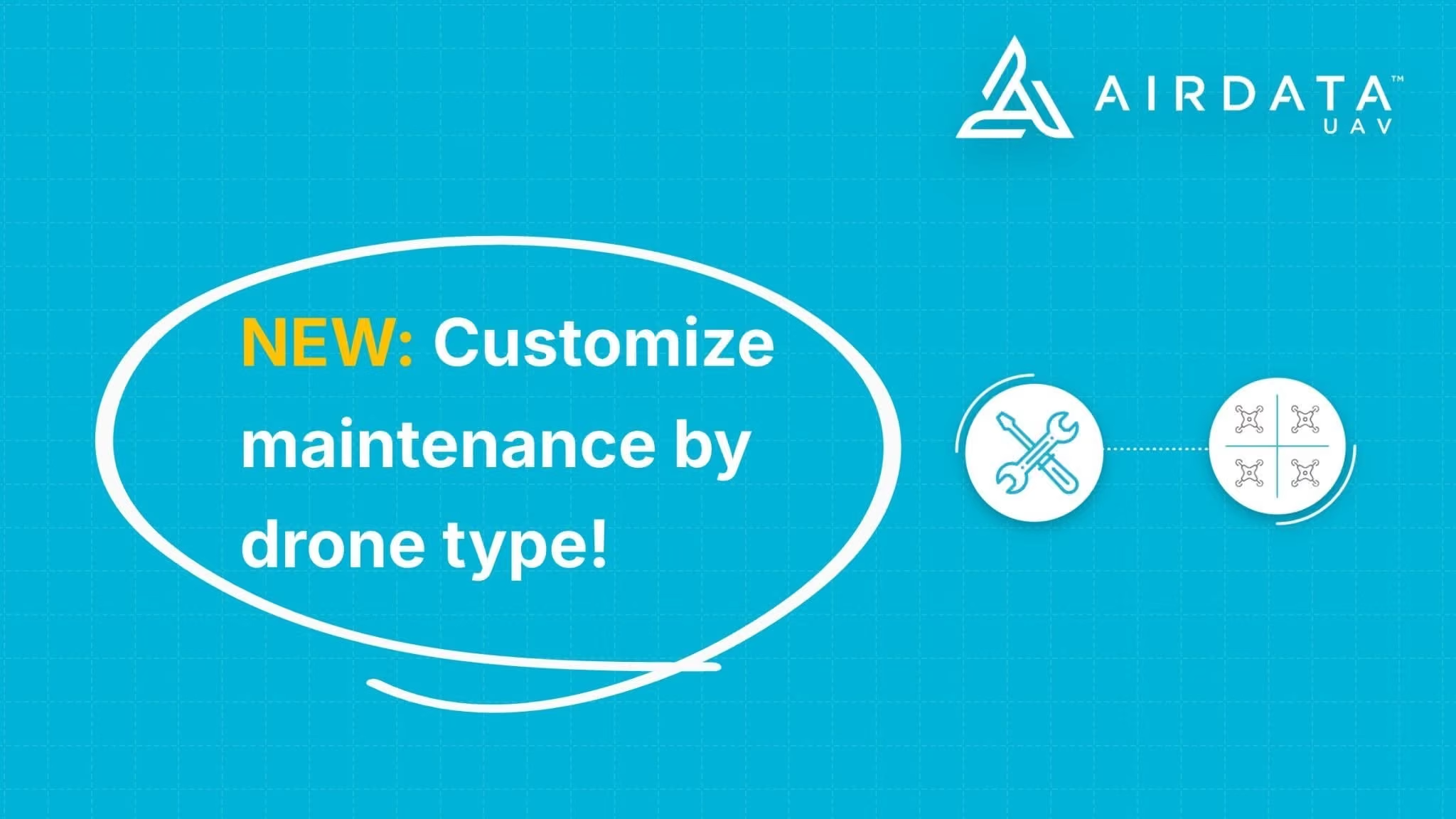
In 2024, we introduced several enhancements to our maintenance management system to provide greater flexibility and control for our users:
Customized maintenance per drone type
Disabling maintenance services
Renaming maintenance service list types
These features are available as part of our Enterprise plan. For a comprehensive guide on utilizing these new features, please refer to our detailed article: Customizing Maintenance.
Additionally, we hosted an in-depth AirTime session where we explored these updates and demonstrated their application within the platform. You can watch the session here: AirTime Session on Maintenance Customization.
Newly Supported Aircraft and Flight Apps
We are committed to expanding our list of supported drones and flight apps, enabling each program to manage their entire fleet in a fully integrated manner.
Drones
Autel EVO Lite Ent
DJI AGRAS T-series
DJI Air 3S
DJI Avata 2
DJI FlyCart 30
DJI Matrice 3D and 3TD
DJI Mini 4K
DJI Neo
Event 38 E400 and E455
Flybotix ASIO
Inspired Flight IF1200
Quantum-Systems Trinity Pro
Teledyne FLIR SIRAS
Teltech XTD-120
Wispr Ranger Pro
Flight Apps
ATAK UAS Tool
INAV
FlytBase
More updates!
Added "Find me" icon to LAANC and mission maps.
You can now duplicate missions.
You can now save a mission as a PDF.
Hovering over a pilot in "Users/Pilots" highlights that pilot.
Added search functionality to dropdown menus.
Introduced created_after URL parameter to the API.
Added the pilot list API.
Added the drone/battery list API.
Added support for knots as a unit of measurement.
Advanced Search now allows searching by coordinates.
Drone firmware version is now displayed for each flight.
LAANC is now available for all plans.
Increased the maximum weight of the 'Risk multi-choice' question to 9 (previously 5).
We recently had our 20th AirTime webinar session! View AirTime.
Events
This year, we participated in major industry gatherings such as AUVSI Xponential and the Commercial UAV Expo, where we gained crucial insights into the evolving needs of our diverse user base. At the Energy Drone and Robotics Summit, we furthered our understanding of the industry’s challenges through meaningful dialogue and collaboration.
Additionally, we attended the PG&E conference and Elevate UAV, where we had the opportunity to engage with industry leaders and customers, further broadening our perspective on UAV applications.
Looking ahead, we are excited to continue engaging with our customers at future events. Your feedback is essential and plays a significant role in refining our products and services. We look forward to meeting you in person and continuing our journey together in advancing drone data management.
We greatly appreciate your ongoing engagement with AirData. Your feedback and support are instrumental in addressing your evolving UAV data management needs. As we continue this journey together, we're excited to bring you more updates and enhancements. Please don't hesitate to reach out with any questions or thoughts. Wishing you safe flying and a Happy New Year!
5 Reasons Drone Resellers Should Add Software to Their Business
November 16, 2026
•
x min read
Commercial drone customers need more than aircraft and accessories. They also need ways to manage flight records, track maintenance, monitor aircraft performance, and keep their operations organized.
For drone dealers and distributors, these needs present an opportunity to sell software alongside hardware.
Adding drone management software to your product lineup can increase revenue per sale, generate annual renewals, and give customers a reason to keep working with you after their equipment is delivered.
Here are five reasons to consider becoming a drone software reseller.
1. Generate recurring revenue
Drone hardware sales depend on new purchases, upgrades, and equipment replacements. Software subscriptions create revenue opportunities between those purchases.
Many drone software platforms offer annual subscriptions, allowing resellers to earn recurring revenue through renewals.
As customers add aircraft, pilots, and departments, they may also need additional software licenses or features. For resellers, this creates opportunities to grow existing accounts without relying entirely on new hardware sales.
2. Increase the value of every drone sale
A drone is only one part of a commercial drone program.
Customers also need to manage flight logs, aircraft maintenance, battery health, pilot qualifications, and reporting.
Offering drone management software alongside hardware helps customers put these systems in place early.
For example, a utility company purchasing several drones for inspections may also need automated flight logging, maintenance schedules, and compliance reports. By including software in the initial sale, resellers can provide a more complete package while increasing the value of each deal.
3. Build long-term customer relationships
Customers may go years between major drone purchases, but their operational needs continue.
Software gives resellers more opportunities to stay involved after the initial sale. As drone programs grow, customers may need additional licenses, equipment tracking, reporting capabilities, or live streaming.
Fleet management software can also help customers monitor aircraft usage, battery health, and upcoming maintenance. This information can inform conversations about replacement equipment, batteries, and fleet expansion.
For resellers, these are opportunities to support existing customers and generate additional business.
4. Serve customers with mixed drone fleets
Many commercial drone programs use aircraft from multiple manufacturers. Different teams may use different drones and flight applications depending on their work. That creates a challenge when customers need a single view of their operations.
Drone management software that supports multiple manufacturers allows customers to bring supported flight records, aircraft information, and maintenance history into one place.
For dealers carrying several drone brands, this makes it possible to offer the same software platform across a wider range of customers. It also means customers can keep using compatible drones and applications they already own.
5. Expand your offerings without additional inventory
Adding hardware products often means purchasing inventory, managing storage, and handling shipping. Cloud-based software doesn’t require physical inventory.
Resellers can add software subscriptions to their existing offerings without stocking another product or managing additional shipping logistics.
Software also fits alongside services many drone dealers already provide, including training, fleet deployment, maintenance, and technical support.
What to look for in a drone software reseller program
Choosing the right software partner matters. The platform needs to work for your customers, and the reseller program needs to make business sense.
Before joining a program, consider:
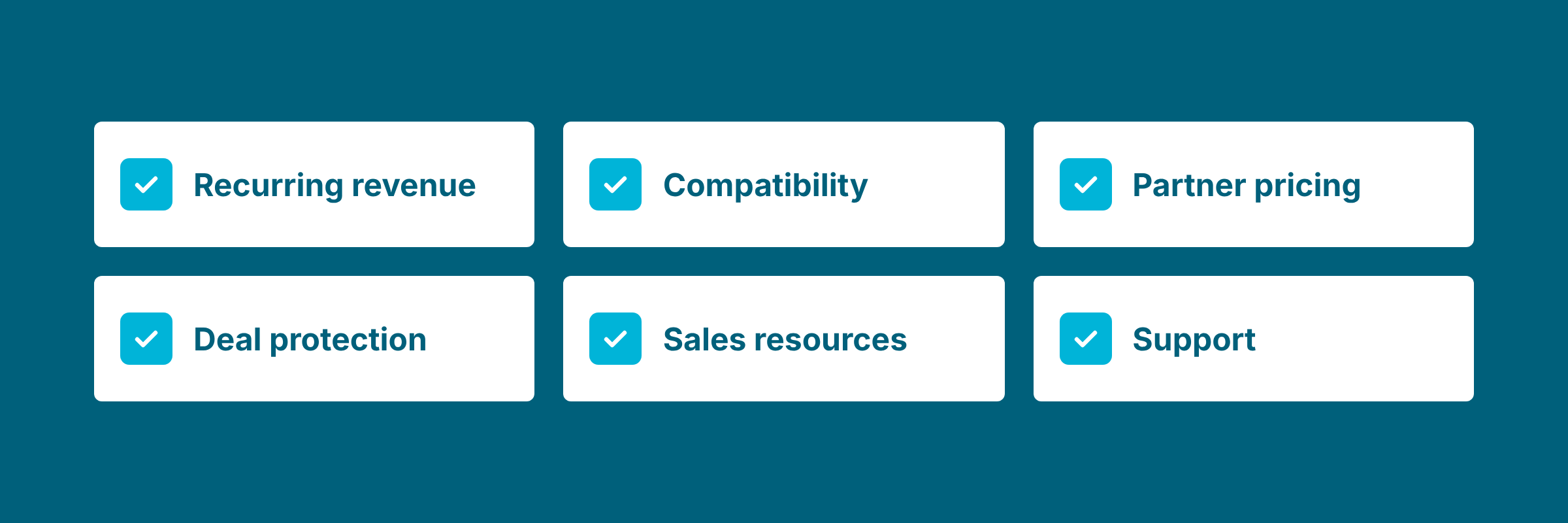
Recurring revenue: Can you earn revenue through annual renewals and account expansion?
Compatibility: Does the software support the drone manufacturers and flight applications your customers use?
Partner pricing: Are discounts and incentives competitive?
Deal protection: Can you register opportunities and protect partner-sourced deals?
Sales resources: Does the provider offer training, demos, case studies, and marketing materials?
Support: Can you get help with pricing, product configuration, and technical questions?
These factors can make a significant difference in how easily you can sell the software and support your customers.
The AirData reseller program
AirData UAV offers a reseller program for drone dealers, distributors, and solution providers looking to add drone management software to their offerings.
AirData is a system of record for drone operations, bringing flight records, aircraft, pilots, maintenance, and compliance into one platform. With support for more than 180 drone types and 60 flight applications, AirData works with many of the drones and applications customers already use.
AirData reseller benefits include:
Competitive partner pricing on annual software subscriptions
Recurring revenue through renewals and account growth
Deal registration for eligible partner-sourced opportunities
Sales resources including training, demos, battlecards, and case studies
Direct support for pricing, scoping, and customer requirements
Marketing support including eligible co-marketing opportunities and reseller listings
Resellers can also offer additional AirData Enterprise capabilities, including Live Streaming, Asset Management, and Rewind & Record.
Become an AirData reseller
Selling drone management software gives resellers another source of revenue and more opportunities to support existing customers.
AirData’s reseller program makes it easy to add software to your product lineup, with no physical inventory required and support from the AirData team.
AirData Insights November 2026: Fleet Overview, Part-Level Maintenance & Part 108 Update
November 9, 2026
•
x min read
Welcome to the November edition of AirData Insights, our monthly roundup of what’s new at AirData and across the drone industry.
This month, AirData added a new Fleet Overview, drone booking, and maintenance tracking down to the part, along with easier night proficiency tracking and new mission approvals. We also met with public safety teams at TEXCON, IACP, and LEDA Washington, and the FAA said Part 108 is close to the finish line.
Pilot Institute certificates import into AirData automatically, both the ones your pilots already hold and new ones as they finish, with the skills attached.
Administrators can see which courses pilots have completed and which are still in progress, along with the skills each one carries. For programs that need to show training records during an audit or before taking on new kinds of operations, that’s one less set of records to keep in sync by hand.
With Part 108 nearing publication, now is a good time to make sure your program is ready for it. Dustin Schocken, Director of Regulatory Affairs & Product Safety at AirData, shares what a program needs in place before the rule lands.
He covers building a just safety culture on real telemetry and incident data, setting GO/NO-GO standards for equipment and people, and training crews on the situations that don’t go to plan.
Great conversations at TEXCON, IACP, and LEDA Washington
Thanks to everyone who stopped by the AirData booth at TEXCON in Arlington, IACP in Orlando, and LEDA Washington. It was great to hear how your DFR and public safety programs are growing, and what you’d like to see from AirData next.
Next stop: ElevateUAV in Miami. Details are in On the calendar below.
The final BVLOS rule has been under White House review since July, and the FAA hopes to publish by year end. It also awarded $12 million to 19 test-site projects. If your program plans to fly under Part 108, Dustin’s readiness post above is a practical place to start while the final text is pending.
Canada, Australia, Brazil, and the UK are each writing BVLOS into their regulations instead of handling it case by case. Worth a read if you fly in more than one country, or want a sense of where the US rule fits internationally.
California, Arizona, and Alabama now all restrict flights over ticketed events, with different boundaries, exemptions, and penalties. Operators say the rules are getting hard to track across state lines, so if you fly near large events or in more than one state, check each state’s rules before the flight.
Most of this month’s releases are about fleet and asset management: seeing your whole fleet at a glance, booking equipment, and tracking maintenance down to individual parts. There are also new dashboards, report options, and updates to Pilots and Missions.
Fleet and asset management
New Fleet Overview Enterprise only
View your entire drone fleet in one place, filtered by checkout status, grounded aircraft, or last check-in, in list or thumbnail view. View your fleet
New Equipment Booking & Calendar View Asset Management add-on required
Reserve drones and equipment independently of missions, and check availability in the new Calendar View, so teams sharing a fleet can see what’s free before they plan. Open the calendar
Track maintenance, service history, and defects for individual components like propellers, motors, and parachutes. Maintenance and equipment reports now include it all. Track part maintenance
Expanded Maintenance Tracking for Items Asset Management add-on required
Schedule one-time or recurring maintenance for cameras, remotes, Remote ID modules, and more. New Items inherit their category’s schedule automatically. View Item maintenance
Mobile Maintenance & Defect Reporting Asset Management add-on required
Scan an equipment QR code in the mobile app to view part details and history, log services, and report defects from the field.
Every open defect in one report Asset Management add-on required
Every defect logged across your equipment in one report, so nothing gets missed before the next flight. Pilots can log one in the field by scanning a QR code. Open your reports
Dashboards and reports
New Operations and Safety dashboards Enterprise only
Flight activity, fleet utilization, maintenance, compliance, and alerts in one view under the Home tab. Open your dashboard
New report designs, with maps and your logo
Standard Flight Reports have a new look, and can now carry an overview map, your logo, landing time, and checklist status. See your reports
Section reports by drone, pilot, or group Enterprise only
The new Section By option in Standard Flight Reports splits reports by drone, pilot, or flight group. Create a report
Pilots and missions
Two updates to the Pilots table
See each pilot’s night hours over the last 30, 60, and 90 days, set inactivity alerts to require a minimum, and toggle inactive pilots off to focus on your active crew. View pilots
Two updates to Missions Enterprise only
Route missions to the right approvers by risk score, airspace, or mission type, and auto-approve the routine ones. The new Mission Summary tracks scheduled, flown, approved, and pending missions for any date range. Open missions
Every flight comes with its full telemetry as well as the summary, so you can look back at altitude, signal strength, wind, warnings, and aircraft behavior from takeoff to landing. It’s useful for incident reviews and training debriefs, or just for understanding why a flight went the way it did.
To find it: open any flight, then click the 3D Player tab.
Gulfstream Park, Hallandale Beach. Live drone demos, manufacturer sessions, and enterprise UAS conversations. Use code AIR20 for 20% off registration.
Dec 6 – 10
IHEEP: see you in Austin
JW Marriott Austin. The International Highway Engineering Exchange Program brings together DOTs, transportation engineers, and agency leaders to share new technology and best practices.
Trevor has spent 6.5 years making sure teams flying with AirData get real value from the platform, and that their feedback reaches the people building it. He also leads our customer success team, which he says mostly means taking credit for their good work.
What excites him most is watching drone programs grow up, from a couple of drones and a spreadsheet to a full record of every flight.
Outside of work, Trevor and his wife recently welcomed their third daughter, leaving him outnumbered four to one. You’ll find him on San Diego’s trails on his e-mountain bike, mostly for the help up the hills.
Operational Readiness: Practical Advice for BVLOS Operations
October 26, 2026
•
x min read
In the near future, some of the first seeds of the fourth industrial revolution will begin to bear fruit. Highly automated robots will begin deploying across metropolitan areas to deliver lifesaving medications, consumer goods, inspect critical infrastructure and even be the first on scene responding to emergency calls. It is important to remember that even though great technological progress is at hand, we currently occupy a transitional space. One that still contains many challenges and uncertainties. Fortunately, we have over 120 years of aviation history and culture to glean insights from. It is in this context that I wish to provide some actionable guidance to help you prepare for what’s ahead. The future of next-generation airspace integration is upon us and I couldn’t be happier.
Operational readiness can be thought of as a state of being. One where an organization, team or individual is prepared to execute its intended functions. This state of being bridges the gap between mission planning and mission execution and oftentimes is the difference between mission success or failure. In order to achieve this state, focusing on three pillars will harness your efforts to transform intention into execution.
Safety
We’ve all heard the phrases. Safety first. Safety is everyone’s responsibility. Safety is common sense. What I find troubling about those phrases is that they are non-actionable. Telling someone to be safe is not much different than saying “good luck” as they embark upon a new adventure. What do they need to know? What do they need to do? To complicate this further, safety is both subjective and objective. Objective examples would be deliberately exceeding operational limitations or breaking from established norms. These and others like it can be measured and managed. Subjectively, what “feels risky” to one person may be completely within another’s comfort zone. So telling someone they should “be safe” or lecturing about “flight safety” is pretty unhelpful without some clear action to take. It is in that spirit, I offer this advice: create a just culture of safety through open communication & honest reporting of mistakes. Meet quarterly as a team and share what you have learned over that period of time. Analysis of flight telemetry, maintenance data and incident reporting are the essential and objective foundations for those quarterly meetings. This is how we learn and grow, by making our own mistakes and learning from the mistakes of others. The best practices and procedures for your organization on how to perform the specific missions you want to achieve will come from the collaborative learning environment a Safety Culture creates. Do this and I promise you will set yourself up for long term success.
Standards
This is a broad subject, especially as it relates to uncrewed aviation operations. An entire white paper could be written about this alone. Some examples of different kinds of standards include regulatory, technical and quality. What I want to highlight for you are performance standards and I’ll give the practical advice up front: identify the required level of performance you need for success and work backwards from there. Specifically, performance standards for two categories: machine and human. What capabilities do you need out of the equipment? What actions do the humans involved need to be able to perform? Asking those questions and others like it early on, will help you identify specific capabilities to look for in the equipment you procure as well as the knowledge, skills and abilities your personnel will need to achieve success. Format these requirements into a GO/NO-GO gating table to perform a comprehensive gap analysis and you have your roadmap. This will help to identify capability gaps and skill-levels that have yet to be addressed. Doing this analysis will save you time, money and loads of frustration.
Training
Training for any aeronautical purpose is about teaching people to develop correct habits and apply them during flight operations. When done with intention, training becomes the ultimate differentiator and creates a competitive advantage top performers can use to distinguish themselves in highly competitive environments. BVLOS operations require human operators to become highly adaptable to 3-dimensional spatial relationships. That means mastering new concepts like system logics, autopilot states, automated system behaviors and the sequence of events that arm and trigger them. For many this will be new, requiring ample practice to become proficient. The instructional methods applied will determine the habit patterns that form.
To be sure, BVLOS is a thinking person’s game. Critical skill development builds the adaptability required to respond to unplanned situations like lost C2 links, degraded GPS or emergency parachute deployments. In my experience, the most effective training programs enhance the learner’s ability to think, adapt and decide before acting. Whether you build this in-house or hire a vendor, you want training that is scenario based and tailored to your missions and the real world operating environments.
I am not going to try to wax poetic here in an effort to wrap this up with a pretty bow. My guidance to you is straightforward. Develop a Safety Culture. Identify your Performance Standards. Implement Scenario Based Training to enhance critical thinking and adaptability to unplanned situations. I’d wish you all luck but perhaps it would be more practical to leave you with one final piece of advice instead: operate with intention, your success will depend on it.
This article provides insights on best practices to prepare for operations under a proposed rule and is provided for information only. It is not legal advice, and it does not represent an FAA determination about any product or program.
Fly solo or manage a fleet.
Choose the plan that fits without changing the equipment or apps you already use.