FAA Part 108 Explained: Everything Drone Operators Need to Know in 2026
%201.avif)

FAA Part 108 is the most significant proposed change to drone regulation since Part 107 came out in 2016. It sets up a formal framework for Beyond Visual Line of Sight (BVLOS) operations, something that has been legally possible through waivers but practically difficult to scale. This post covers what the rule proposes, who it affects, what the industry is pushing back on, and what operators should be doing right now.
What Is FAA Part 108?
FAA Part 108 is a proposed rule focused on highly automated drone operations. The goal is to replace the current system of individual waivers and exemptions with a standardized, scalable framework that lets operators plan and run routine BVLOS flights. Operators would still need approval for each operation, much like in crewed aviation, but without going through the arduous waiver process each time.
Right now, BVLOS flight is legal under Part 107 only with an FAA granted waiver. Getting one takes time, the scope is limited, and other operators can’t easily build repeatable programs around them. Part 108 is designed to fix that. It covers a wide range of use cases: long-range delivery, infrastructure inspection, precision agriculture, public safety, surveying, and more.
BVLOS Today — Part 107 Waivers
1. Apply for a waiver
2. Wait through case-by-case FAA review
3. Receive a narrow, one-off approval
4. Repeat for every new operation
BVLOS Under Part 108
1. Qualify once for a permit or certificate
2. Get streamlined per-operation approval
3. Run routine, repeatable BVLOS missions at scale
The proposed rule runs more than 600 pages and is the most substantial update to commercial drone regulation since Part 107 was introduced in 2016.

Why Does Part 108 Exist? A Brief Timeline
• 2021 — BVLOS Rulemaking Committee Formed
The FAA formed the BVLOS Aviation Rulemaking Committee (ARC) to address the need for updated regulations enabling more complex drone operations.
• 2022 — ARC Report Released
The BVLOS ARC delivered a 381-page report with 70 detailed recommendations for the new Part 108 rule.
• 2024 — FAA Reauthorization Act
Congress mandated the creation of a Part 108 rule to address BVLOS operations, reflecting urgency to establish standardized regulations across the industry.
• June 6, 2025 — “Unleashing American Drone Dominance” Executive Order
President Trump signed Executive Order No. 14307, directing the FAA to issue a proposed rule enabling routine BVLOS operations and finalize within 240 days.
• August 7, 2025 — NPRM Published
The Part 108 Notice of Proposed Rulemaking was officially published in the Federal Register (90 FR 38212, Docket FAA-2025-1908), opening a 60-day public comment period.
• October 6, 2025 — Comment Period Closed
Nearly 3,100 comments were submitted. More than half addressed the proposed right-of-way rules.
• January 28, 2026 — Limited Comment Period Reopened
The FAA reopened comments on the proposed right-of-way and electronic conspicuity requirements, the most contested issues in the proposal. The reopened window closed February 11, 2026.
• July 10, 2026 — Rule Sent to OIRA for Final Review
The final rule reached the Office of Information and Regulatory Affairs (OIRA) for review, its last major stop before publication. OIRA targets a July 2026 release and its review of significant rules can run up to 90 days, so timing beyond that window is still to be confirmed.
• Next — OIRA Sign-Off and Final Rule
Once OIRA completes its review, the rule can publish in the Federal Register, followed by an effective date (typically 30 to 60 days out) and staggered compliance dates. Allowing for the OIRA review window, a published final rule is most likely in late 2026 or into 2027, with full implementation expected a year or so after that.
Part 107 vs. Part 108: What’s the Difference?
The Two Authorization Levels Under Part 108
The proposed rule requires operators to obtain one of two authorizations before conducting BVLOS flights:
Operating Permit
For lower-risk, limited-scale operations:
• Package delivery
• Agriculture monitoring
• Rural infrastructure inspection
• Training and recreational BVLOS
Operating Certificate
For higher-risk or complex operations:
• Larger aircraft or fleets
• Operations over populated areas
• High complexity highly automated missions
• Requires Safety Management System (SMS)
New Roles: Who Does What Under Part 108?
One of Part 108’s core changes is moving compliance responsibility from individual pilots to the operating organization. Two new roles are required under the proposed framework:
Operations Supervisor: Responsible for the overall safety and logistics of every flight operation. This person is the final authority on safe and secure operation of all unmanned aircraft. Qualified through training, experience, or demonstrated expertise.
Flight Coordinator: Handles tactical oversight of individual aircraft during live operations, monitoring flights in real time and intervening when needed. Each flight coordinator can oversee multiple aircraft simultaneously.
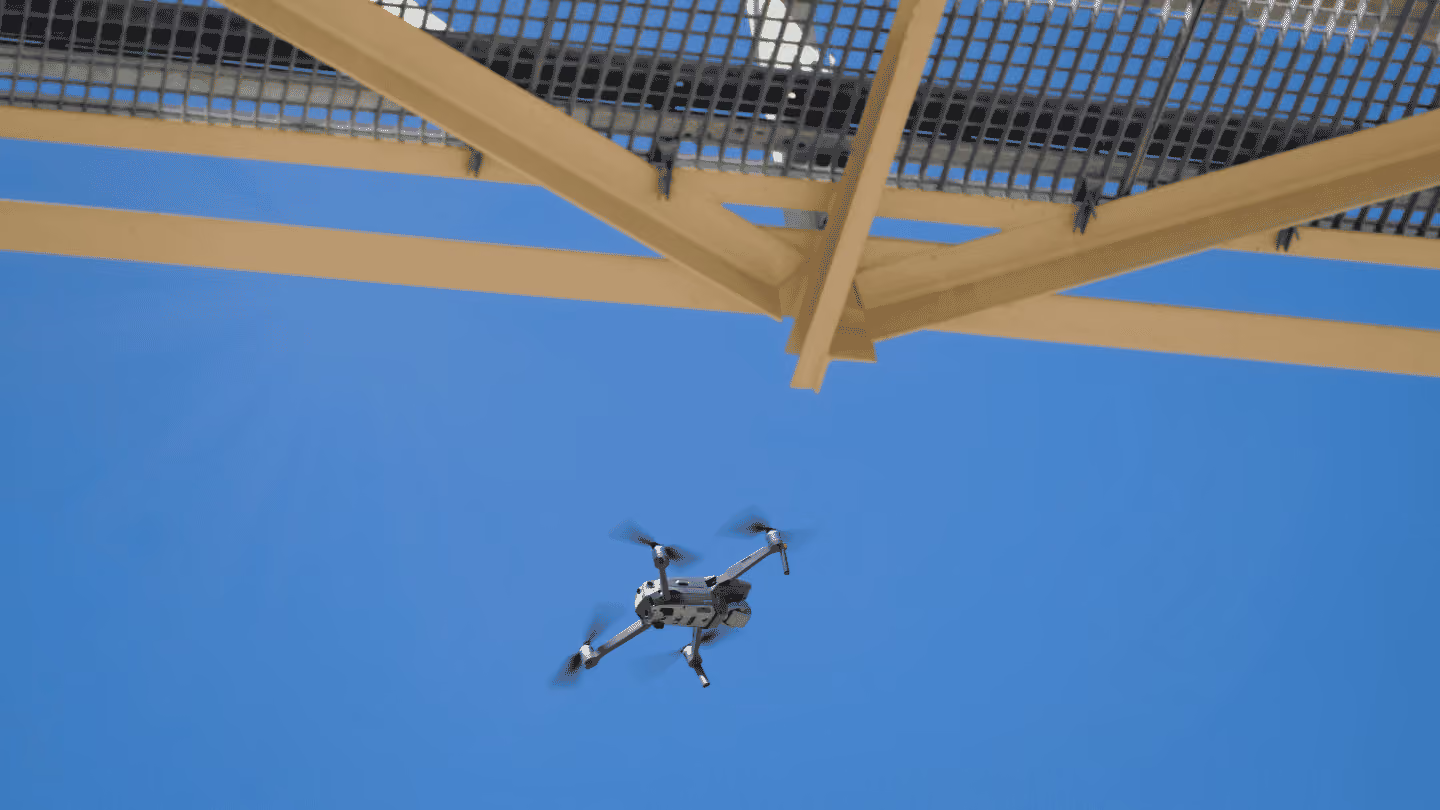
Technical Requirements: What Drones Need to Fly Under Part 108
Part 108 sets performance-based standards rather than prescriptive rules. Key technical requirements include:
Electronic Conspicuity: Electronic conspicuity refers to technologies that allow aircraft to digitally broadcast their position and identity so other airspace users can detect them. Routine BVLOS operations require that all aircraft and traffic management systems understand who is operating nearby, maintain safe separation, and document compliance with emerging right-of-way and detect-and-avoid requirements.
Remote ID: Drones must broadcast their identity and location at all times while operating. This is the most common form of drone electronic conspicuity.
Detect-and-Avoid (DAA): Drones must yield right of way to crewed aircraft broadcasting via ADS-B (another form of electronic conspicuity), using onboard or ground-based detection systems.
Redundant Systems: No single power or propulsion failure can result in loss of flight control.
Conformance Monitoring: The aircraft must continuously compare its actual position and behavior against its declared operational intent. When deviations are detected, the system must alert the operator and, where applicable, other aircraft in the area.
Cybersecurity Protection: Systems must resist electronic interference and unauthorized access.
Anti-Collision Lighting: Must be visible from 3 statute miles.
Airworthiness Acceptance: Manufacturers are responsible for demonstrating airworthiness rather than the FAA issuing a type certificate.
What Should Drone Operators Do Right Now?
1 - Audit your current operations. Figure out which missions would fall under Part 108 rather than Part 107. Long-range inspections, delivery routes, dock-based missions, and anything highly automated should be your starting point.
2 - Review your documentation practices. Part 108 has broad requirements covering pre-flight, in-flight, and post-flight records. Your logs, checklists, and maintenance history need to be complete and easy to produce on request.
3 - Check your fleet’s technical readiness. Does your current hardware support Remote ID, ADS-B detection, and the redundancy requirements in the proposed rule? Better to find gaps now than during a compliance review.
4 - Think through personnel roles. Who in your organization could qualify as an Operations Supervisor or Flight Coordinator? What training would they need? These aren’t roles you want to staff reactively.
5 - Get your compliance infrastructure in order. Part 108 will require maintenance records, pilot currency tracking, operational safety management, operational histories, and documented risk management procedures. AirData’s platform covers all of this today. Operators who have it organized before the final rule publishes will be in a much better position to move quickly.

AirData Is Already Built for What Part 108 Requires
AirData is a comprehensive system of record for the flight, maintenance, and compliance data a drone program depends on. It keeps one authoritative source of truth across your operation, so records stay complete, audits are easy to support, and conflicting information never slows you down. Without a single trusted record, a growing drone program is flying blind. Part 108 will require operators to maintain detailed, auditable records for safety, maintenance, training, and more, and AirData gives you the structure to handle that volume as your program scales.
The platform automates the work Part 108 will demand: compliance documentation creates itself, digital checklists and flight logs are captured automatically, pilot currency and maintenance records stay current, and fleet-wide analytics give program managers clear visibility into operational risk. Part 108 changes more than what you can fly. It changes how your entire operation is documented, managed, and proven compliant. Operators who build that record now will have a real advantage when the rule takes effect.
AirData is trusted by more than 460,000 pilots across 232 countries and territories, with 64M+ flights and roughly 10 trillion data points behind it, the largest known dataset in commercial drone operations. As a member of the Commercial Drone Alliance, we’re helping shape the standards coming out of the BVLOS rulemaking process.
Start an enterprise trial at app.airdata.com/enterprise
Build the record Part 108 will require, before the rule lands: Download the Part 108 Guide
Frequently asked questions
Not yet, but it is moving. As of July 2026, the rule has not been finalized. The original executive order deadline was February 1, 2026, extended by a 43-day government shutdown to approximately March 16, 2026. On July 10, 2026, the rule reached the Office of Information and Regulatory Affairs (OIRA) for final review, its last major step before publication. OIRA’s review of significant rules can take up to 90 days, so a published final rule is most likely in late 2026 or early 2027. Once finalized, implementation would likely include a transition period of 6 to 12 months before requirements take effect.
No. Part 107 remains in place for visual line of sight operations. Part 108 is a separate regulatory tier for organizations running highly automated BVLOS missions. It is not a replacement for the framework most drone pilots use today.
Probably not right away. For many routine Part 107 pilots, the immediate impact will be minimal. Part 108 becomes relevant if you’re operating from a drone dock, conducting virtual pilot missions, or running long distance highly automated operations. If you want to scale into those capabilities, Part 108 is what you’ll need.
Up to 1,320 lbs (including payload), with a wingspan under 25 feet and ground speed up to 87 knots. For context, a Robinson R22’s max takeoff weight is 1,370 lbs, only 50 lbs more than the heaviest drones covered under Part 108. That is a significant jump from Part 107’s 55-pound limit.
Part 108 has no FAA licensing requirement. The organization, not the individual pilot, is accountable for ensuring personnel meet training requirements and documentation standards and follow operational manuals and procedures. This is one of the more significant philosophical shifts in the proposed rule.
Yes. Operators conducting air transportation for compensation under Part 108 must comply with DOT regulations for air carriers, which include requirements for liability insurance. These federal requirements are designed to protect both the operator and the public from unintentional damages. Operators may also need to obtain economic authority from the Office of the Secretary (OST), depending on the nature of their operations.
ADSPs are FAA-certified third-party services that provide near real-time data to help operators stay clear of other aircraft. That includes traffic awareness, weather feeds, and strategic deconfliction. They function as air traffic services built specifically for the drone ecosystem.
This is actively being debated. The current proposal would eventually eliminate the ability to obtain new Part 107 BVLOS waivers, but industry groups are pushing hard for a grandfathering pathway that recognizes operators with proven safety records under existing waivers.
The biggest day-to-day change is documentation. Because Part 108 shifts compliance responsibility to the operating organization, operators will need complete, auditable records covering maintenance logs, pilot currency, battery health, and operational safety. A platform like AirData tracks all of this automatically, so operators can demonstrate compliance the moment the rule takes effect.
Significantly. Manufacturers are now responsible for obtaining FAA Airworthiness Acceptance rather than relying on the FAA to issue a type certificate. This shifts the compliance burden earlier in the product development process and applies only to manufacturers based in the US or countries with bilateral airworthiness agreements.
Executive Order 14307, signed June 6, 2025, directed the FAA to publish a final Part 108 rule within 240 days of the NPRM, putting the original deadline at February 1, 2026. A 43-day government shutdown extended that to approximately March 16, 2026, and on July 10, 2026 the rule advanced to OIRA for final review. As of July 2026 the final rule has not yet been published, though the momentum behind it remains stronger than any previous drone rulemaking.
Focus on the current flight and grow your operation.
Use the drones and flight apps you already have, with no new tool for pilots to learn before AirData starts adding value.