Menlo Park Fire Protection District: Elevating Public Safety Operations with AirData

Background & Objectives
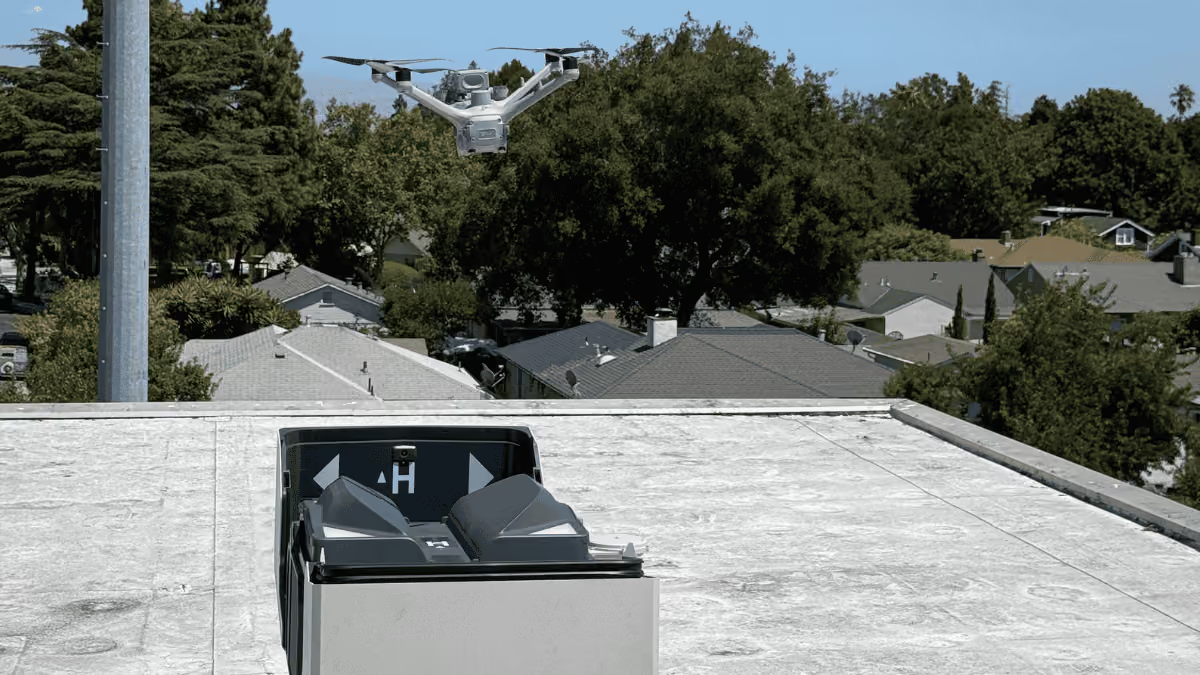
Menlo Park Fire Protection District (MPFPD), located on the San Francisco Peninsula in Northern California, has operated a UAS program since 2014. Over time, the program has evolved from manually deployed aircraft to include Drone as First Responder (DFR) operations.
The goal is straightforward: deliver timely, relevant aerial intelligence to support decision-making for incoming crews and incident command.
The program is led by Tom Owen, a Senior Management Analyst who has been with the district for over six years. With a background in the private sector, he has focused on building an operationally grounded program that prioritizes real-world usability, accountability, and measurable outcomes.
Today, MPFPD operates a fleet of over 15 aircraft supported by 14 trained pilots, along with three dock-based DFR systems deployed across the district.
Key operational priorities include:
- Ensuring the right people can access the right live video feed at the right time without confusion
- Maintaining fleet safety and aircraft reliability across a growing inventory of pilots, aircraft, and batteries
- Building a data-driven program that can demonstrate
Challenges & Solutions
Challenge: Managing Live Aerial Feeds
As the program expanded, managing live video feeds became increasingly complex. UAS operations are pilot-driven, meaning the active video stream depends on who is flying at any given time. Previously, this required command staff to know which pilot was operating and select the corresponding video link.
While the number of simultaneous flights is typically limited, the uncertainty of which pilot is airborne required incident command to identify and select the correct feed during active incidents, adding unnecessary steps in a time-compressed environment.
At the same time, the expansion from one to three DFR docks introduced three persistent, location-based video feeds. Tablet Command plays a critical role in delivering these feeds to crews and command staff, but screen space and available bookmark slots are finite.
As the number of potential video sources increased, presenting those feeds in a clear, consistent, and limited format became essential.
Solution
AirData’s Multiview Player provides a single access point for UAS video feeds, removing the need to identify which pilot is operating. Regardless of who is flying, command staff can access UAS video through a consistent entry point.
This allows Tablet Command to maintain a simplified interface, presenting a limited and predictable set of video options, including the three DFR feeds and a single Multiview entry point for UAS operations.
By reducing the number of selectable channels and removing pilot-specific ambiguity, Multiview minimizes confusion and eliminates the need to search for the correct feed during active incidents. The result is faster, more reliable access to aerial intelligence for incident command.
Challenge: Fleet Safety and Battery Reliability
With well over 100 batteries across the fleet, tracking the health and reliability of each battery is a significant operational concern. A single compromised battery can result in in-flight failure, and without consistent data capture across every mission, there is no reliable way to identify patterns before an issue occurs in the field.
Solution
AirData’s automatic flight logging and battery tracking provide the data needed to proactively manage fleet safety. Following a battery-related incident, the team used historical data to identify the anomaly and audit the rest of the fleet for similar warning signs, removing potentially compromised batteries from service.
As Tom put it, “You don’t know you have a problem until you get one. But the fact that the data exists about the battery, the flight, and the aircraft, that is the proactive safety net.”
Challenge: Demonstrating Program Value
As the program expanded, there was a need to consistently capture and present operational data in a way that aligns with how the fire service evaluates performance. The fire service is inherently metrics-driven, and new capabilities need to demonstrate value within that same framework.
To be effective, the UAS and DFR program needed to deliver clear, reliable data that reflects how these tools contribute to operations, not as a standalone capability, but as part of the overall response.
Solution
AirData’s keyword tagging and reporting capabilities provide the foundation for documenting and categorizing every flight. Immediately after each mission, flights are tagged by mission type and call category while still at the console.
This structured dataset allows the program to proactively generate operational metrics and present them in a format that aligns with existing performance measures. Rather than reacting to requests for information, the program consistently delivers data that supports command staff and Board-level visibility into how these tools are being used.
As Tom described it, “It’s one thing to show what these tools can do. It’s another to provide the data that proves the value. That’s what makes the difference.”
Results
The use of AirData in support of Air Operations objectives enables MPFPD to deliver several operational improvements:
- Simplified live feed management: A structured streaming approach reduced confusion and improved access to live video during incidents
- Proactive fleet safety: Battery tracking enabled the identification and removal of at-risk batteries before additional incidents occurred
- Program accountability: Structured flight data provides leadership with clear insight into program activity and supports continued investment
With a background working with these tools in the private sector, Tom emphasizes the importance of accountability in building a sustainable program: “If you're going to stand up a program and present it to leadership, you need a system that supports accountability. It shows you’ve thought through implementation, training, and operational risk, and that you have the data to back it up. That’s when the data starts working for you.”
View our recent AirTime webinar with Tom here: https://vimeo.com/1187858965?fl=ip&fe=ec
Focus on the current flight and grow your operation.
Use the drones and flight apps you already have, with no new tool for pilots to learn before AirData starts adding value.